Thursday, October 18, 2012

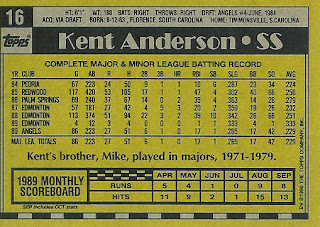
#16-Kent Anderson


Kent Anderson was coming off his first of two season in the majors both with the Angles. Signed out of the University of South Carolina in June of 1984 he would become the second member of his family to play in the bigs. His brother Mike was a reserve outfield for the Phillies, Cards and Orioles during the 1970's.
Kent debuted on April 15, 1989 going 2 for 4 in the Kingdome flying out to Henry Cotto in the 2nd. In the 5th he got his first base hit-a single to center-off Scott Bankhead. The next day, in the sixth inning he drove in his first RBI-scoring Chili Davis. His first error came April 25 while hosting the Orioles.  In 86 games hit .229 with 0 HR's and 17 RBIs. 
In 89 he suffered through some bouts of a strained hamstring that reduced his playing time. In late April 1990, Anderson slammed into Minnesota catcher Brian Harper and knocked the ball lose "He changed the mindset of the whole club with one overt play," Angels manager Doug Rader said. His hitting improved to a .308 clip and he hit his first and only HR on June 24 at the Big A with the Tigers' Frank Tanana being the victim. Put on the DL in August he returned to the DL in late September with more hamstring issues. With Donnie Hill already on the team-having joined the Angles in 1990-and Bobby Rose a younger and cheaper option he spent the next year at AAA with the Angles team in Edmonton and was released following the season. He spent the next several years bouncing between the Cubs and Reds minor league affiliates before calling it a career in the mid-90's. 

Friday, October 12, 2012

#-15-Teddy Higuera


Teddy Higuera was coming off the first, of what would be the norm for the remainder of his career, injury plagued season. Prior to that he had been an  dominating lefty for the Brewers. After spending several seasons in his native league he came to camp with the Brewers in 84, at the age of 26, and made the team the next year.  A 15-8 with a 3.90 and 212.1 innings lead to a 2nd place finish in the Rookie of the Year Award. 
In 1986 he won 20 and dropped his ERA over a whole point. He was also a runner up again though this time it was for the Cy Young Award finishing second to Roger Clemens. Higuera had a WAR of 9.1 that year while Clemens had a 8.6. How great was Higuera that year? He had the best WAR in all of baseball it was so good that Wade Boggs had a 7.9 and was the highest rated everyday player. Mike Scott who had his career year with the Astros had a 7.8. He had two more excellent seasons when in 89 began the injuries. 1990 was his last full season going 11-10 but in 91, 93-94-his missed all of 92-he was a combined 5-10 with a 6.34 over 125 innings. He tried to catch on with the Padres but was released before the season and retired afterward. 
More than likely a spring training shot since the only stadium that had low fences like the ones shown here was County Stadium in Milwaukee and he is wearing the Brewers' road uniform, so more than likely its in the spring. 

Tuesday, October 9, 2012

#14-Mike Fetters


This card makes me want some orange juice. Other than that what else can I say? Mike Fetters was a journeyman who had a very long career in the game going from his debut in 1989 until 2004, thus racking up 16 years in the bigs. 
Pitching out of the pen he saved 100 games in his career his best season being 1996 with the Brewers when he saved 32 games. His reward was to be replaced the next season by Doug Jones. He finished his career with a 31-41 mark and an ERA of 3.86. A high WHIP of 1.465 and a WAR of 6.9. His best WAR season was 1992 with the Angels and a 2.2. His big save season only racked up a 1.3. 
One thing no one could do was take a bad picture with those old style Angels' uniforms. If anyone asks; no I can't stand their current bland red unis. 

#13-Mark Williamson


Out of the darkness came the pale man with the word 'Orioles' written in large script on the front of his jersey. Oh, not like you didn't think the same thing too. Williamson was coming off his best season and the next one (1990) would be another good one for him. 
Drafted by the Padres in the fourth round of the 1982 draft. His long stay in the Padres minors took him from Reno in the California League to Beaumont in the Texas League and  Las Vegas in the Pacific Coast League. In October of 1986 Williamson was sent to the Orioles along with Terry Kennedy for Storm Davis. Not a great deal for the Padres I think its safe to say. The next season it was the International League and the old O's AAA team at Rochester. 87 and 88 were spent bouncing between Baltimore and Rochester. Pitching out of the bullpen for his minor league career he made the most starts in his pro career with the O's in 88 making 10 starts. 
In 89 he was 10-5 with a 2.93 ERA and a career best WAR of 2.2. Another good season in 90 would be his last as he began a slide. From an 8-2, 2.21 with a WAR of 2.1 he slumped over the last four season to a combined 15-11, 4.25 and a WAR of 0.1. Granted free agency at the end of the 94 that marked the end of his career. 
One highlight came on July 13, 1991 he along with Bob Milacki, Mike Flanagan and Gregg Olson combined to no-hit the Oakland Athletics. Starter Bob Milacki went the first 6 innings with no-hits but 3 BB and 3 Ks. Mike Flanagan faced four batters, walking one but kept the no-hitter going. In the 8th Williamson came in and retired his first batter, Mike Gallego on a pop out to first. Pinch-hitter Rickey Henderson hit a ground ball to third and was thrown out at first. Willie Wilson came to the plate and sent a ground ball to the second basemen who threw Wilson out at first. Gregg Olson finished off the game in the ninth by striking out Harold Baines.  

Monday, October 8, 2012

#12-Joe Girardi


Lets sum it up like this, journeyman catcher, awarded Manager of the Year with the Marlins who rewarded Girardi by firing him and went on to manage the New York Yankees and already has one World Series ring. (2009). 
Debuted in 1989 with the Cubs he was a weak hit great glove catcher for the Cubs, Yankees, Rockies and Cards. Was an All-Star for the Cubs in 2000 and won three Worlds Series with the Yankees. (1996, 1998-1999). 
What else can you say about a 70's style catcher? 36 homeruns in his career and not much else. As a manager he certainly has had much more of an impact. 
As for the card itself, it appears it is either a spring training 'in action' shot or taken at the old Jack Murphy Stadium in San Diego. 

Wednesday, October 3, 2012

#11-Paul Gibson


So far the first couple of player cards have been noting really worth noting, until now. How many ways can you foul up a card? Maybe the flaming purple border or the hideous glasses that even Elton John would have found too big! The reddish orange belt and piping around the jersey top matching nicely with vibrant red seats in the background. Gibson looks like he is all of nine-years-old in the pic and that just adds to the photographic carnage this card front is. 
As for Gibson, he was a journeyman lefty who ended up with a 22-24 record with a 4.07 ERA and a slightly high career WHIP of 1.448. Just in case anyone asks you one day: "What was Paul Gibson's career WAR?" Well little Billy that answer is 2.5. He was about to enter upon his best season in the Majors in 1990 where he had a 5-4 record with a 3.05 ERA. He was an old school lefty who pitched in 97 innings in 61 appearances so he wasn't like todays one out lefties. The next two seasons were a drop off with 92 being spent with the Mets then 93-4 and a brief return in 95 again wearing the pinstripes but wasn't as effective as he had been and his career ended that year. He made his debut in 1988 as a 28 year old with the Tigers where he went 4-2 with a very good 2.93. He also had the misfortune of reaching the Tigers the year after their post-season appearance and his career ended the year the Yankees returned to post-season and won the series. 

Tuesday, October 2, 2012

#10-Barry Larkin


If its #10 it must be a good player and it is. Hall of Famer Barry Larkin who coming off an injury plagued 1989 season. One of the remarkable things about the Reds of the mid-80's was the crop of young players they came up with. Besides Larkin, there was Paul O'Neil, Chris Sabo, Tom Browning, Rob Dibble, John Franco, Norm Charlton and the great one Eric Davis. No wonder they would win the World Series in 1990. 
Larkin debuted in 1986 but only became a regular the next season. One of his best defensive season was 1990 where he racked up a defensive WAR of 2.2 and had a career WAR of 13.8. Named National League MVP in 1995 with a .319 Avg. 15 HR's and 66 RBI's. Not exactly Miguel Cabrera numbers but his 51 SB's and 98 R's helped show how all around his game was . His 6.9 WAR for 1996 was his best season accruing to those numbers with 33 HR's, 98 RBI's and 117 RBI's, but those impressive numbers only got him a 12th place finish for the leagues MVP well behind the confessed PED user the late-Ken Caminiti                                                                                                                                                                                              
                     His career continued on its steady HOF way until 2000 when at the age of 36 his defense began to fall off and his offense the next season. He played on until 2004 when his career came to an end. This year he was, much deservedly, induction in the Hall of Fame.